
The turtles of Oakland County

By Mark H. Stowers
Dinosaurs, lizards, and turtles all roamed the Earth some 200 million years ago. Although dinosaurs became extinct, the other two survived and still inhabit the planet. Turtles are more prevalent in warmer climates, with 357 known species worldwide, 10 of which call Michigan home. This diverse array of turtles is vital to the ecosystem, spanning wetlands, lakes, rivers, and streams. They serve as “garbage collectors” and play an essential role in the food chain, providing benefits for both animals and humans. Many face significant challenges due to human activities and environmental changes. Understanding their life cycles, nesting behaviors, and conservation needs is essential for ensuring their survival.
Throughout Michigan, the Department of Natural Resources (DNR), county parks and recreation, Michigan State University (MSU), and other colleges and organizations collaborate to monitor the declining turtle population and educate the public on how to coexist with these prehistoric, slow-moving creatures.
One of the state’s turtle experts, retired Michigan State University educator James H. Harding began his career in 1969 while pursuing his master’s degree. Like the turtles he studies, the esteemed herpetologist and lecturer emeritus at MSU has been methodical and steady in gathering and sharing his findings and knowledge. Of the 10 turtle species in Michigan, Wood Turtles have been his favorite and the focus of much of his work.
Harding grew up in the metro Detroit area before extensive urbanization, where there were many trees, streams, and wetlands to explore and play in. Thanks to his parents, his love for turtles began early in life. After moving to a new subdivision at the age of five, he still found plenty of unexplored wildlife.
“It was still surrounded by woods and not too far from the Rouge River, and I found a Painted Turtle walking through our yard,” Harding said. “I picked it up and I showed it to my father and said, ‘Can I keep it?’”
His dad acquiesced a bit and offered to put it in the sandbox with a little water so they could watch it and then release it.
“By the end of about three or four days, it let itself go,” he said. “And my father says he regrets his next move. Jokingly, he bought me the little Golden Nature Guide to Amphibians and Reptiles. I just carried it around with me all the time and started identifying the things I found. I was just totally fascinated.”
The budding herpetologist started “raising” turtles he could find at stores. He bought Red Sliders and some Map Turtles with a little bit of food and sparse habitat but each met its demise and Harding buried them in the backyard, replete with a homemade wooden cross.
“There were always remains of little crosses where I buried all my failures until I finally figured out how to care for them and realized that if you take good care of them, they'll last longer than you do,” he said.
With the practical knowledge he gained from the original book, Harding has penned his own, "Michigan Turtles and Lizards: A Field Guide and Pocket Reference," with co-author J. Alan Holman. Harding earned his undergraduate degree in zoology and his master's in fisheries and wildlife management. He even started a Ph.D. track, but his wife was in medical school at the time, and there was only enough time “for one doctor” in the house. Even though he is retired, he still spends time pursuing his boyhood interest. He began his career at Cranbrook, working for eight years as an interpretive naturalist and engaging in herpetology wherever he could.
“I set up a big turtle tank in the nature center there and kept a big black rat snake for use in programs,” he said. “Eventually, my wife took a job at MSU, and I just sort of sidled my way in there. I went back and saw my old professors and they kept me busy and it worked out pretty well. I ended up teaching herpetology in the zoology department for 25 years.”
Harding, along with numerous biologists and researchers continue to study Michigan’s native turtles. Michigan is home to ten native turtle species, each with its own unique characteristics and ecological roles.

The Blanding's Turtle (Emydoidea blandingii) is recognizable by its bright yellow throat. This species is known for its gentle nature and is listed as a species of special concern in Michigan. In Michigan, Blanding's turtles are primarily found in the Lower Peninsula, with less common and more localized populations in the Upper Peninsula. They are semi-aquatic and prefer shallow, weedy ponds, marshes, swamps, and lake inlets with muddy bottoms and abundant vegetation. As omnivores, they eat insects, crayfish, snails and slugs, small fish and tadpoles as well as frogs, leeches and worms. They also eat plant materials.

The Map Turtle (Graptemys georgiana) is named for the map-like patterns on its shell and resides in larger rivers and lakes. Found in the Lower Peninsula, particularly in southern and central counties, they also live in larger bodies of water such as rivers, lakes, and reservoirs, as well as smaller streams. These turtles are known to consume a variety of items, including aquatic insects, mollusks, small fish, and crustaceans.

The Eastern Musk Turtle (Sternotherus odoratus), known as the "stinkpot," emits a musky odor when threatened. It is a tiny animal, averaging about four inches long, very aquatic and only found in the lower peninsula. They are a typical species found along the edge of a lake in a weedy part of the waterway. These turtles have been hit hard by the habit of spreading herbicides in lakes to kill off the vegetation. These herbicides can have a direct, unhealthy effect on turtles, as the herbicides kill off all the plants that they hide in. Found in southern Michigan, Eastern Musk turtles dine on a variety of aquatic organisms, including insects, crustaceans, and aquatic vegetation.

The Snapping Turtle (Chelydra serpentina) is a large, aggressive turtle commonly found in slow-moving rivers and lakes. As the heaviest turtle species in Michigan, it inhabits various freshwater environments, including lakes, rivers, ponds and marshes. These opportunistic omnivores consume both plant and animal matter, such as aquatic plants, insects, fish, frogs, birds, small mammals, and carrion. Snapping turtles prefer shallow, muddy, or brackish waters with abundant vegetation for hiding and ambushing prey. They can also be found in areas with large boulders, undercut banks and root balls.

The Eastern Box Turtle (Terrapene carolina carolina) is notable for its hinged shell, which allows it to close completely. In Michigan, it is the only turtle that remains on land and is classified as a species of special concern. As omnivores, they consume both plant and animal matter and primarily inhabit the southern and western parts of the Lower Peninsula, especially in areas with mixed hardwood forests and wooded habitats. They are locally common in the southwestern counties, but their range has diminished due to habitat loss and other factors.

The Painted Turtle (Chrysemys picta) is the most widespread turtle in Michigan, easily identified by its colorful markings. It averages five to six inches in length and possesses a shiny black or olive shell adorned with yellow stripes, and sometimes red stripes if found further south. This turtle is very common and is often observed crossing roads in the spring throughout the state, particularly in freshwater habitats such as ponds, lakes, marshes and slow-moving streams. It is also prevalent in the Upper Peninsula and the northern third of the Lower Peninsula. Its diet includes aquatic plants like duckweed and cattails, insects, snails, crayfish, mollusks (including zebra mussels), and small fish, especially those that are dead or injured. Young painted turtles are primarily carnivorous, feeding on insects, crustaceans, tadpoles, fish and snails. As they mature, their diet shifts towards more herbivorous options, comprising a larger proportion of plants. These opportunistic omnivores consume berries, mushrooms and carrion. They have been observed eating fish, frogs and reptiles that fit in their mouths.

The Red-eared Slider (Trachemys scripta elegans) is recognized as an invasive species in Michigan. It competes with native turtles for resources and has become widespread due to "pet owners” releasing them into the wild. Commonly found in freshwater habitats such as rivers, lakes and ponds, its diet includes aquatic plants, small aquatic animals, insects and fish. As omnivores, these turtles consume a variety of foods, including aquatic plants, insects, small fish, tadpoles, and even carrion. They have been observed in the watersheds of Lake Michigan, Lake Erie, and Lake Ontario, as well as in areas like Muskegon, Lansing, and Oakland County.

The Spiny Softshell Turtle (Apalone spinifera) is recognizable by its soft, leathery shell and pointed snout. It is typically found in the Lower Peninsula, particularly in the southern and central counties. They inhabit rivers, lakes, marshes, ponds, and bays of the Great Lakes, favoring areas with a sandy or muddy bottom and minimal vegetation. Their diet consists primarily of aquatic invertebrates like crayfish, insects, and occasionally small fish. They also consume mollusks, earthworms, and other organisms, often ambushing their prey by hiding in the substrate.
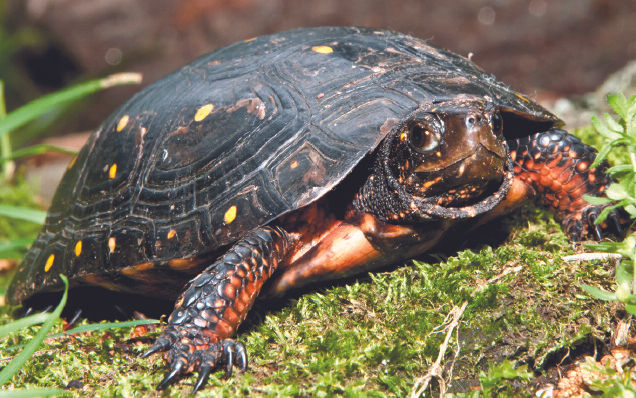
The Spotted Turtle (Clemmys guttata) is characterized by its black shell decorated with yellow spots, and it is listed as threatened in Michigan. It is primarily found in the southern and western parts of the Lower Peninsula, specifically in and around wetlands with shallow, clean water and a mud or silt bottom. These turtles are omnivores, meaning they eat both plants and animals, including algae, aquatic plants, snails, worms, and insects.

The Wood Turtle (Glyptemys insculpta) inhabits sandy-bottomed rivers and streams and is recognized as a species of special concern in Michigan. These turtles are predominantly found in or near flowing water and associated riparian habitats, especially in the northern regions of the Lower and Upper Peninsulas. They also utilize nearby terrestrial habitats during the summer. Wood turtles are omnivorous, feeding on a variety of plant and animal materials, including berries, insects, worms, and carrion. They are more frequently observed in the northern areas of the Lower and Upper Peninsulas.
Harding did offer an alibi for the Red Eared Slider’s rap as an invasive species to Michigan.
“For a while there, people thought that all the sliders in Michigan had to have been introduced through the pet trade. And then a while back, in fact, one of my first professors at MSU found remains of Red Eared Sliders in 2,000-year-old Indian middens in the Saginaw Bay area,” Harding said. “That proved that the Red Eared Slider had made it into Michigan all on its own. Not that its numbers weren't augmented by the pet trade.”
Turtles are among the longest-living creatures on Earth, but this is both a blessing and a curse for their existence. While some species often reach the century mark in age, each species takes nearly a decade (and even two decades) before both males and females reach sexual maturity. This makes them quite vulnerable.
Each turtle species becomes more active in the spring and early to mid-summer. That’s when nesting occurs, as females search for sunny, sandy, or soft soil areas near water to lay their eggs. Using their hind legs, the females dig a shallow nest cavity, lay their eggs, cover them, and leave. Incubation takes up to two months, with weather playing a significant role in determining the sex of the eggs. A hot summer produces more female eggs, while a cooler season results in male eggs. This phenomenon is known as temperature-dependent sex determination, making turtle populations sensitive to climate changes during nest incubation. Landowners and those who find turtle nests should also pay attention to the brush surrounding a nest. Clearing too much of it can change the sex of the eggs, allowing either cooler or warmer temperatures to prevail. Each species lays a different number of eggs each year.
“A box turtle will lay an average of about six eggs. A Blanding's turtle will lay an average of about ten eggs. And then you've got Snapping turtles, which are big and the females are able to carry more eggs. They can lay anywhere from 25 to 80 eggs or more,” Harding said.
Professor Frederic Janzen from the W. K. Kellogg Biological Station and the Departments of Fisheries and Wildlife & Integrative Biology, Ecology, Evolution, and Behavior Program at Michigan State University explained that turtles don’t mate for life with one partner. The slow-moving reptiles “get around.”
“Even within the same nest, on average, a third of the eggs will have more than one dad,” Janzen said. “Turtles are playboys and the females can store sperm, too, so they can go for several years even without remating and still produce eggs.”
But the females do tend to stick with the same nesting area year after year.
“There seems to be relatively minimal migration, especially for the females. They seem to be very biopatric, meaning that they kind of hang out in the fatherland. They stay close to that area. They do disperse away from shore and spend the year out in the slough, river, or lake, and so forth. But when it comes time to reproduce again, year after year, you catch those same females and the males, too, in the water when we're doing aquatic trapping. Females come back to the same nesting area over and over,” Janzen said.
Several turtle species in Michigan face significant threats and are protected by state regulations. Environmental groups, along with state and federal agencies, assess whether a turtle species is endangered through a process that involves scientific evaluations of population trends, habitat conditions and threats to the species. The Michigan Natural Features Inventory (MNFI) plays a crucial role in reviewing the state's turtle species and making recommendations for their conservation status. The Michigan DNR evaluates these scientific assessments and makes decisions regarding the protection status of turtles. The U.S. Fish and Wildlife Service (USFWS) conducts its own independent review and may list a species under the Endangered Species Act if it determines that the species is at risk of extinction.
The categories of designation and protection include "species of special concern," which refers to species that are not currently endangered but are at risk of becoming so due to threats. Additionally, there are "threatened or endangered” species if scientific evidence indicates that a species is facing a high risk of extinction.
Blanding's Turtle is listed as a species of special concern as it is threatened by habitat loss and road mortality.
“The Blanding's turtle is found throughout the Lower Peninsula and in a few, very limited areas of the Upper Peninsula,” Harding said. “It's not a large animal, but it can reach the length of a football, boasting a smooth, high shell and a very even temperament. They never bite and they have a claim to fame with their bright yellow back and chin beneath the chin.”
Eastern Box Turtle is also of special concern. It faces similar threats and is especially vulnerable due to its slow reproductive rate.
“The Eastern Box Turtle is the only truly terrestrial turtle in the state, found in western and southern Michigan, at least formally,” Harding said. “It's a woodland and woodland edge species, grows to about six inches long, and has a somewhat helmet-shaped shell, generally adorned with many yellow markings, though highly variable,” Harding said. “No two box turtles look exactly alike. Box turtles are like fingerprints. They are also considered threatened.”
The Spotted Turtle is listed as threatened and is affected by habitat degradation and predation. Destruction of their specialized wetland habitats and exploitation by pet collectors have led to a severe decline in the population. In Michigan, Spotted Turtles are generally rare and confined to small, localized colonies.
“They’re found in very specialized little boggy habitats. Spotted turtles don't like deep water. They're very pretty little animals,” Harding said. “And they are considered a threatened species and given a very high level of protection. They are only found in the Lower Peninsula, in very specific habitats.”
The Wood Turtle is a species of special concern. It is impacted by habitat loss and road mortality.
Conservation efforts for these species include habitat restoration and nest protection, along with public education. For instance, organizations like the Sleeping Bear Wildlife Fund are actively involved in turtle conservation through events such as Turtlefest, which is held each May in Elberta and Grand Rapids, helping to raise awareness and funds for turtle protection initiatives.
The Spotted turtle, along with the musk turtle, is the smallest species in the state, and it only gets up to around four or four-and-a-half inches long. And it's found in very specialized little boggy habitats.
“Spotted turtles don't like deep water. They're very pretty little animals with a black shell with little yellow spots all over them. And they are considered a threatened species in the state,” Harding explained.
Michigan turtles face numerous challenges that threaten their survival, including road mortality, habitat loss, and predation. Female turtles migrate to their nesting sites and often have to cross various types of roads. Vehicles thus become a significant factor in their lifespan, and since turtles typically take nearly a decade to reach adulthood, removing just one from the population can negatively impact the entire community due to very low egg hatching rates. DNR Fisheries Biologist Tom Goniea explained more.
“Roadkill can be high enough to affect local populations and likely is the largest direct loss of adult turtles by humans,” Goniea said. “Turtles don’t begin mating and laying eggs until the age of 8-10 years and have extremely low natural mortality rates as adults. If not crushed by a car tire, they can and often do live for many decades. Their low mortality as adults and ability to lay eggs annually for 20-50 years is necessary to overcome the extremely high mortality rate of juveniles and losses of turtle eggs.”
The natural predation of turtles – the circle of life – focuses on the eggs and baby turtles, which are easy targets and “tasty morsels for Michigan’s racoon, opossum and skunk populations. A floating baby turtle is also irresistible to bass or wading birds like great blue herons,” Goniea said. “As a result, the conservation of these animals really hinges on the protection and survival of adults, who have already survived the gauntlet of predator threats as juveniles themselves.”
Turtles need to sustain themselves and live such long lives – 50 to 100 years – to reproduce and maintain stable populations.
“The margin on adult turtle populations is so slim that a six percent annual mortality for adults is often enough to threaten sustainability and push local populations toward local extinction,” Goniea said. “Let that sink in for a second. That means in a population of 100 adult turtles, if six or more are lost every year, the population could decline and eventually disappear.”
When developers build more homes and businesses, and lake owners “harden” their shorelines with seawalls and apply herbicides, these actions collectively destroy turtle habitats. Turtles must travel farther to nest, which increases their risk of danger and harm. Female turtles typically return to the same areas to nest and lay eggs. However, the greatest threat to turtle survival comes from raccoons. These clever and resourceful animals dig up turtle nests and feast on the eggs, destroying nearly all that they find.
Goniea gets about 50-100 calls and emails from concerned citizens who have turtles in their yards and gardens during nesting season.
“A lot of times, they call and they're looking for things that they can do to maybe help the nest or protect the nest and things like that,” Goniea said. “I usually recommend putting a four-foot by four-foot piece of chicken wire and brick on each corner over the nest, which just makes it a little more difficult for the predators to get at. And it also lets yard workers know where the nest is when working and mowing.”
The chicken wire allows heat and air to flow but provides protection. He recommends removing the structure by the Fourth of July to not interfere with the hatchlings.
“It's a harmless way for people to help the turtle population. They're helping that individual, so the mortality rates on nests in Michigan exceed 75 percent, but in localized areas, nest predation can reach 90 percent.”
Raccoons can be harvested year-round using all legal hunting and trapping methods for these species on private property when causing or being physically present where they could imminently cause damage. Damage refers to physical harm to forest products, roads, dams, buildings, orchards, apiaries, livestock, and horticultural or agricultural crops.
The Michigan DNR only requires hunters to purchase a fur harvester's license for $15 and a valid base license for $11. There are no established seasons or bag limits. Raccoons can be hunted year-round, both day and night. Researchers lack a complete understanding of why raccoon populations are so high, other than the fact that the overseas fur trade dwindled in 2008, allowing the animals to survive and thrive on human waste, particularly in improperly secured trash cans. Opossums and skunks also prey on turtle eggs.
Turtles benefit the ecosystem by consuming plants, including invasive species that can create problems in Michigan's lakes, streams, and rivers. They also eat mosquitoes and other insect larvae. These omnivorous reptiles also act as local aquatic garbage collectors.
“Some aquatic turtles are scavengers. They eat a lot of dead stuff that's in the water. If you have a dead fish floating in the water, instead of rotting, Painted turtles and Snapping turtles come up and eat it. They all have their usefulness,” Harding explained. “They will eat almost anything they can catch, eat, or find that's remotely edible. Snapping turtles are usually thought of as carnivorous, but they also eat a lot of plants. On the other hand, a Blanding turtle doesn't know what to do with a plant. They eat mainly crayfish and aquatic insects, maybe the occasional fish, but they're not very good at catching them.”
The best way to help turtles is to leave them alone. Unless a turtle is in danger on the road, experts all agree that it should be picked up and placed in the direction it was headed. If not, it will still attempt to cross the road, putting itself back in danger. Additionally, don’t take them home with you.
“Box turtles prefer to stay in their environment. In fact, they can remain within a few acres their entire lives. When you remove an adult turtle from its environment, even if you take perfectly good care of it, it's still dead to its ecosystem. It’s dead to its habitat. It's gone. It doesn't matter whether you run over it or take it home and love it; it's still gone. There are only so many out there. If they suffer high mortality and most of their eggs are eaten by rats and raccoons, while many of their hatchlings do not survive to adulthood, you can see the problem. Therefore, turtles shouldn't be harvested. They should just be left alone,” Harding said.
For homeowners and especially lake property owners, the best thing to do is just leave them alone.
“Whatever turtles are left in a lake are probably going to have to nest on people's lawns. The one thing you can do is to tolerate that. Keep the lawn mowed short in the springtime and don't use toxic chemicals on the lawn and allow them to be there,” Harding said. “We don't need to put chemicals in this lake. The fish need some cover. Turtles need some cover. Frogs need some cover. Their tadpoles need some cover. We'll get ducks nesting and all kinds of food for the ducklings. If you're a lakeshore owner, you can certainly enhance the situation.”
Janzen suggested, “Planting native vegetation around the water's edge, as opposed to having a Kentucky bluegrass all the way up to the front. And the reason there is that you get a lot more runoff and erosion if you have just lawn. And that's not good for the water quality, which is important. But also, that native vegetation is going to be something that the turtles will more positively cue in on.”
Another suggestion for landowners is to build or put in basking platforms for turtles. Fallen trees or platforms for turtles to crawl out of the water and sun themselves and also create an easier way to reach the shore if there is a hardened shoreline or seawall.
Researchers use a combination of shell notching and radio tagging to keep records and data on Michigan turtles. Each researcher has his own notching key or language that helps keep up with notched turtles. The turtles are repeatedly found and data is recorded.
“I was out with Jim (Harding) probably 10 to 12 years ago, and we found a turtle that he marked in 1967,” Goniea said. “It hadn't gone very far from where it was marked. Now, it may have moved during that time. If you've got a lake, it might be on this side of the lake versus that side of the lake. If you've got a river, maybe it went upstream for 10 years, but found its way back down.”
Janzen, a former college baseball player, has been working in the field since the 1980s, starting on the Mississippi River in Illinois. Part of his research involves notching and tagging turtles for data collection and research.
“I've been taking students from Michigan State from station for field work,” Janzen said. “We conducted long-term studies looking at the effects of human changes in habitat, as well as rapid environmental changes, and how those are affecting the populations of turtles at that particular location over the course of several decades.”
Notching and tagging was at the center of the research according to Jantzen.
“Turtles live a really long time and you need a way to be able to identify them and to do this kind of capture. You make a mark or notch and then you release them. When you catch them again you learn something about population structure and size and how many males and females.”
As many turtles as possible are tagged, but not any hatchlings. Janzen pointed out that a variety of turtles actually have growth rings similar to those of trees. While not as specific as those found in trees, growth and age can still be estimated from the size and thickness of the rings.
“Those rings are really wide on the young ones because they're growing so much. And then the adult, once they reach maturity, they refocus their energy into making eggs or making sperm. They're not growing as much. Those growth rings tend to become really narrow,” he said. “There are some folks that drill a hole in the scutes around the edge of the margin of the shell. Others will make a V-shaped notch with a file. There are 12 of those scutes around the edges, and researchers will notch a different combination of those uniquely for each turtle. So, that process is similar for everybody, but how they count them and what they call those; like some people will use letters, some will use numbers, and have different counting systems.”
Oakland County lakes have their fair share of ten specific species. Cleyo Harris, a DNR fisheries biologist, maintains turtle data while sorting through fish data.
“We typically handle turtles as we do with our lake surveys. We catch them when we set up entrapment gear around the lake for our fishery surveys. We also catch a bunch of turtles,” Harris said. “We try to make sure that they can get air because our nets are set overnight. The other thing we try to do is ensure that we're not sampling too late into the spring, because once the water temperatures get closer to 75, their turtle's metabolism is up so high that they can't hold their breath quite as long.”
Of the 97 lakes surveyed, 36 were in Oakland County. Each percentage reflects the number of lakes where the biologist recorded observations of each species during the surveys: Blanding – 3 percent; Map – 74 percent; Musk – 84 percent; Painted – 75 percent; Red-Eared Slider – 8 percent; Common Snapping – 63 percent; and Spiny Softshell – 70 percent.
“We're measuring them and keeping track of all the different species we catch and we occasionally will catch a pretty rare Blanding turtle and then the Red-Eared Slider,” Harris said.
Sean Zara, an Oakland County parks biologist, also keeps tabs on turtles and other reptiles and amphibians in the Oakland County 15-park system. He noted one of the four protected turtles – the Blandings – has been found.
“Not as rare as the other three rare species but they do occur in county parks, and they occur in a lot of our county parks,” Zara said. “They're actually still fairly common in Oakland County. We have the perfect habitat circumstances for them. They like the fact that we have a lot of lakes and wetlands, more so than the surrounding areas of the state.”
When Blandings are found, Zara photographs the underside of the shell because the patterns of black dots are quite distinctive.
“You can usually figure out who's who just from a photo. You can tell if you've caught that individual before just from a collection of photos,” he said.
Zara has created brochures for various bird and animal species in Oakland County parks and is currently working on a brochure for turtles.
“I encourage people to go out and spend some time along the lakeshore or on the fishing docks with a pair of binoculars and a field guide and see what turtles you can find,” he said.
A.J. Fetterman is a biologist who was educated and trained at Oakland University and now works for the Turtle Survival Alliance. Prior to this, he was employed by the Herpetological Resource and Management, a consulting company for construction firms. They specialized in safely removing reptiles and amphibians from construction corridors.
“We would palpate any female turtles found. That's just where you take your finger, usually your pinky, and you can feel up inside the leg pit and feel for any eggs. If we found a female, in the construction corridor and she was gravid, which is what we call a pregnant turtle with eggs, we would bring her back to the facility and induce her to lay those eggs or wait for her to lay those eggs. Then put her back into the wild. We would let the eggs hatch, give them a little bit of food, let them get started and then let them go.”
According to their website, “Survival Alliance is a worldwide organization in 18 different countries “that works as a global conservation organization to create a planet where tortoises and freshwater turtles can thrive in the wild. They use science-based initiatives directed by local leaders, inspiring sustainable, community-based stewardship to prevent extinctions.
Fetterman said, “I personally am doing mostly captive assurance colony work in population management. There are many turtles in the United States that are being illegally taken for the pet trade and being sent overseas. So, the organization I work for partners with a lot of zoos and aquariums to handle the confiscations that are taken from primarily JFK and LAX. And there are primarily Eastern Box Turtles but there are a lot of species that are being collected and sent primarily to Asia but overseas in general.”
And when the fickle Michigan weather decides to start turning toward the cool side, all Michigan turtles will soon start their hibernating process.
“They all hibernate in different ways,” Goniea said. “We have one turtle species that is a terrestrial turtle, that's the Box turtle. They are going to hibernate in essentially leaf litter and stuff like that. They're going to bury themselves in that kind of thing in the fall. All the rest of your turtle species in Michigan are aquatic and will hibernate in the water.”
There are species that hibernate in rivers and some in ponds.
“A majority hibernate on the bottom of the lake,” Goniea said. “They're going to bury themselves in the muck. But I've been an ice fisherman my entire life, and I've had snapping turtles crawl across on the bottom underneath my ice fishing hole.”
And no matter when a turtle is found, Goniea gives the same educational advice.
“Unless you find a turtle in the middle of the road or in the middle of a parking lot somewhere, then that animal is exactly where it's supposed to be. Unless it's in a specific location where it's in immediate danger, and typically the danger is being squashed by a car tire. If that's not the case, then that turtle is exactly where it's supposed to be. I get calls all the time from people telling me they found a turtle and there's no water around. Turtles wander all over the place. They're able to do pretty vast overland movements and stuff like that. They're perfectly fine.”


